
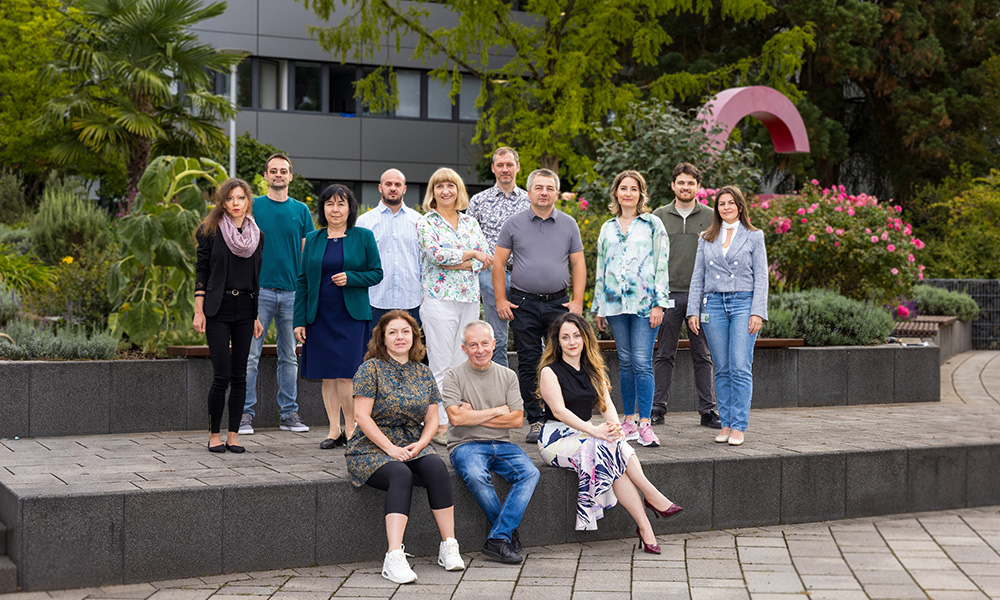
Prof. Dr. Penka Petrova took part in a scientific delegation to Heidelberg which discussed future partnerships, the training of young researchers and access to Europe’s leading infrastructure in the field of life sciences.
In September, a group of Bulgarian scientists visited the EMBL headquarters in Heidelberg. During the visit, the participants were introduced to the organisation’s wide range of scientific research, infrastructure resources and technological capabilities, with a particular focus on genomics, molecular systems biology and modern research infrastructure. The programme provided an opportunity for direct dialogue with EMBL scientists, the exchange of expert knowledge and the discussion of prospects for expanding scientific collaboration.
The delegation included representatives from the Bulgarian Academy of Sciences, the Medical University of Varna, the Medical University of Pleven and Sofia University “St. Kliment Ohridski”. They were joined by the national representatives for cooperation with EMBL Stoyno Stoynov, Deputy Director of the “Acad. Roumen Tsanev” Institute of Molecular Biology at BAS, and Mikaela Stancheva, Chief Expert in the “Science” Directorate at the Ministry of Education and Science.
During the visit, the Bulgarian delegation held meetings with heads of research groups at EMBL and toured the facilities for state-of-the-art light and electron microscopy, including the EMBL Imaging Centre, as well as the platforms for high-tech “omics” research. The participants also learnt about the capabilities of EMBL’s mobile laboratories which provide access to cutting-edge technologies and support scientific research both in specialised laboratories and in real-world field conditions.
The meetings with leading scientists and the presentation of the modern scientific infrastructure opened up new prospects for cooperation between Bulgarian scientific organisations and the EMBL. Among the delegation members was Prof. Penka Petrova who discussed opportunities for developing joint research in the fields of genomics and immunology, as well as prospects for the training and specialisation of Bulgarian PhD students and early-career researchers at EMBL. “It was inspiring to learn about the scientific work at EMBL and to compare our own work with what has been achieved in Bulgaria,” said Prof. Dr. Penka Petrova. “We look forward to future joint initiatives, and in particular to the opportunity for our PhD students to work at EMBL and learn new methodologies. I was particularly impressed by the research in the fields of genomics and immunology – areas that are developing rapidly and which we wish to expand and strengthen in Bulgaria.”
The visit was seen as an important step towards deepening cooperation between EMBL and the Bulgarian scientific community. In future, the partnership will continue to develop through the exchange of expertise, access to scientific services and infrastructure, and by expanding opportunities for training, professional development and international scientific collaboration as part of Bulgaria’s preparations for full membership of EMBL.