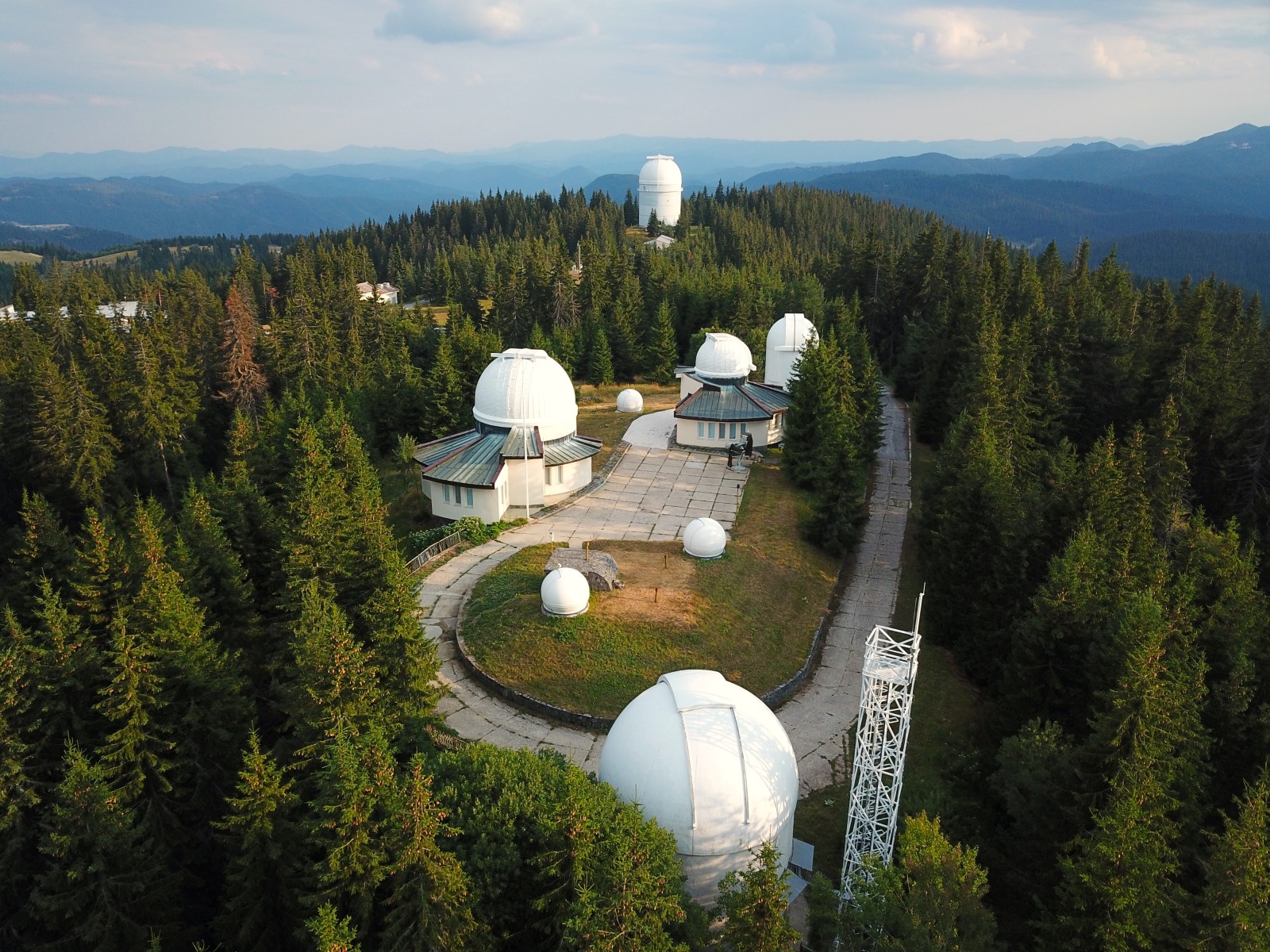

An aerial view of the completed LOFAR-BG station shows the low-frequency and high-frequency antennas as well as the computing container.
Source: Kamen Kozarev (IA with NAO, BAS)
The construction of the two antenna arrays and the associated infrastructure for LOFAR-BG – Bulgaria’s first professional radio telescope and part of the pan-European LOFAR radio telescope network – has been successfully completed. The project was realised as a result of international collaboration between the Institute of Astronomy with National Astronomical Observatory (IA with NAO) at the Bulgarian Academy of Sciences, AstroTec Holding B.V. and the Netherlands Institute for Radio Astronomy (ASTRON). The facility, located in the immediate vicinity of the Rozhen National Astronomical Observatory, will be the 53rd station in the European network and the first in South-East Europe. The final stage of the process is now underway: the full certification of the station and the start of scientific operations which is expected in early 2027. “The completion of the Bulgarian LOFAR station is a landmark moment for our community,” said Michiel van Haarlem, Executive Director of LOFAR ERIC – the international organisation that coordinates and manages the LOFAR telescope. “As the most remote station in the network, it provides the longest baseline lengths for LOFAR and opens up new opportunities for high-resolution radio astronomy. I would like to extend my warmest congratulations to our Bulgarian partners and the observatory team whose dedication and perseverance have made this achievement possible.”
The construction of the station was led by a team of experienced engineers and technicians from ASTRON, employed by AstroTec Holding, with the active participation of over 25 students, PhD students and early-career researchers. They were divided into three groups during the summer of 2026 as part of a specially organised radio astronomy internship. It was the interns who carried out the bulk of the work involved in installing the hundreds of low-frequency and high-frequency antennas on site, with most tasks being performed by hand. All the students received special certificates for their participation in the creation of Bulgaria’s first station in the LOFAR network.
“We are extremely pleased with the successful completion of the LOFAR-BG station and with the strong international collaboration that made it possible,” commented Prof. Kamen Kozarev, Director of IA with NAO and coordinator of the LOFAR-BG national consortium. “Once it becomes fully operational, it will provide Bulgarian scientists with the opportunity to conduct research in various fields of astronomy, space physics and geophysics.” The project also envisages building technological capacity to process petabytes of data using artificial intelligence methods, training the next generation of scientists to work with the telescope, and expanding the consortium to include new partners.
LOFAR-BG is not only the first station in the network in South-East Europe but also the southernmost and easternmost station of the international LOFAR telescope. Thanks to its location, it extends the network’s longest baseline to around 2,500 km which will contribute to a significant improvement in the angular resolution and image quality obtained by the telescope. The LOFAR-BG project is funded under the National Roadmap for Scientific Infrastructure (2020–2027), coordinated by the Ministry of Education and Science. The project is being carried out by a national consortium comprising IA with NAO (coordinator), the Technical University of Sofia (Department of Radio Communications and Video Technologies), Sofia University “St. Kliment Ohridski” (Department of Astronomy) and “Konstantin Preslavsky” University of Shumen (Department of Physics and Astronomy). Bulgaria is a founding member of LOFAR ERIC.
The idea for LOFAR-BG was conceived in 2018, and in May 2020 the project was officially approved for inclusion in the National Roadmap for Scientific Infrastructure (2020–2027) of the Ministry of Education and Science. Since then, the team at IA NAO, together with partner universities, ASTRON and AstroTec, has been working actively on building the infrastructure – from the delivery of key computing equipment to the installation of hundreds of low-frequency and high-frequency antennas at the site near Rozhen.
The LOFAR-BG consortium (https://www.lofar.bg) works in close collaboration with ASTRON (https://www.astron.nl) – the organisation that manages the international LOFAR network on behalf of LOFAR ERIC. LOFAR ERIC (https://www.lofar.eu/) is an independent legal entity established by the European Commission in December 2023 with the aim of managing, optimising and modernising the Low-Frequency Array (LOFAR) system; its members are Bulgaria, the Czech Republic, Germany, Ireland, Italy, the Netherlands, Poland, Sweden and the United Kingdom.