
Rare diseases affect 1 in 2,000 people which means over 350,000–400,000 Bulgarians and at least 30 million Europeans. To date, 7,000–8,000 rare diseases have been identified, the majority of which are of unknown origin, and over 90 per cent of which have no treatment. Elucidating the molecular mechanisms underlying these diseases is of paramount importance for medical science and human health.
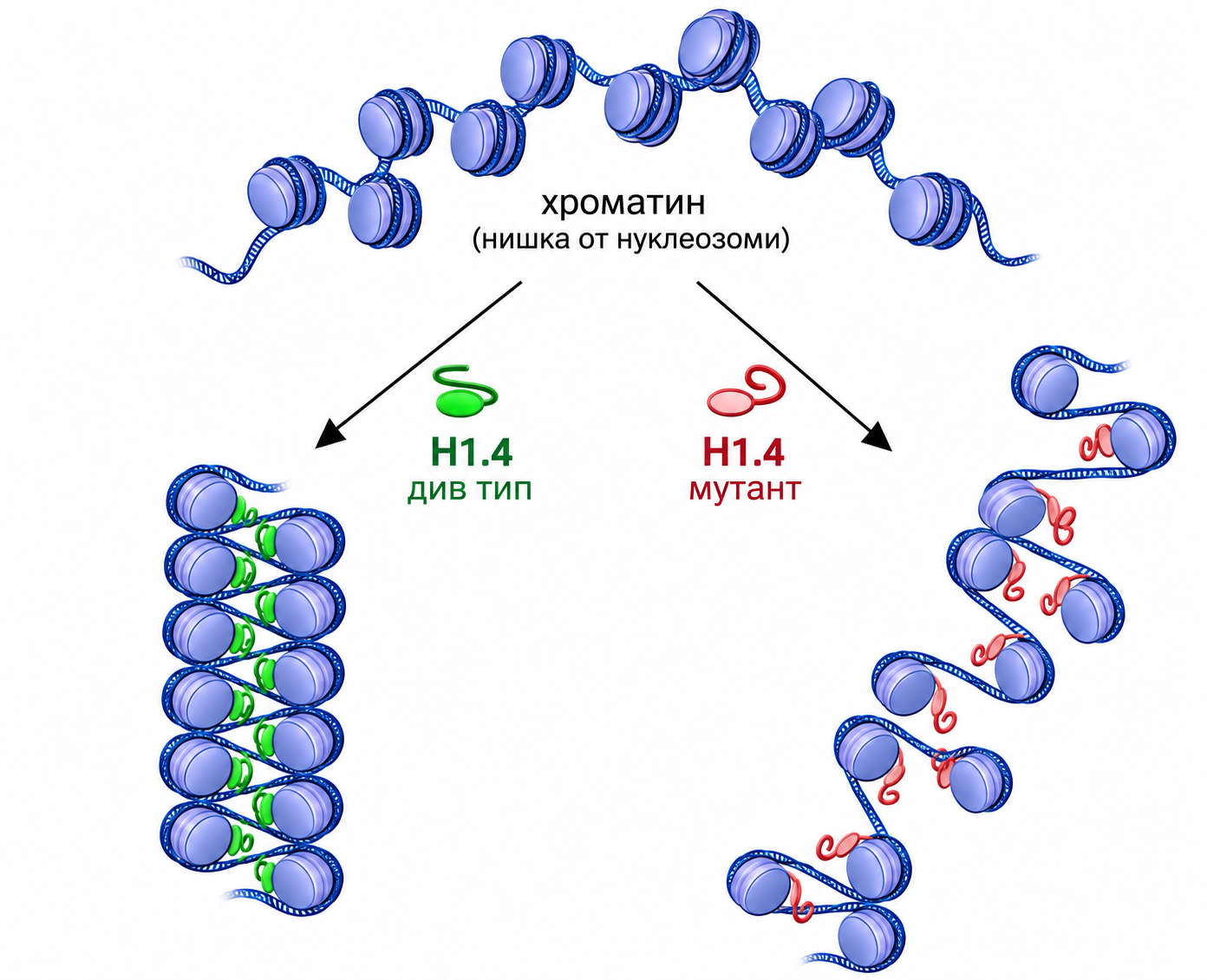
A diagram comparing the effect of normal histone H1.4 and its mutated form on an array of nucleosomes. Every human cell contains 30 million nucleosomes (the basic building blocks of chromatin), and each of these consists of four core proteins around which the DNA is wound. The DNA is represented by blue lines wound around the four proteins (grey circles). The individual nucleosomes are linked by DNA to form the nucleosome array. The histone H1.4 (in green), by interacting with it, condenses these 30 million nucleosomes into a compact structure (the image on the left). Conversely, the mutated form of H1.4 associated with Rahman syndrome (shown in red) is unable to compact the nucleosome array which hinders the reading of genetic information and underlies the disease.
Rahman syndrome is a rare genetic disorder associated with severe neuropsychological developmental disorders and characteristic facial features. Its manifestations are varied and may include premature ageing, cardiac or skeletal abnormalities as well as visual or behavioural disorders. For several years now, the medical community has been aware that Rahman syndrome is caused by mutations in the H1.4 gene. This gene is responsible for the production of a specific histone protein that plays a role in the packaging of DNA within the cell nucleus. And while doctors were well aware of the cause of the condition, until now it remained a complete mystery exactly how this genetic defect disrupted the body’s processes. The new international study provides the long-awaited answer demonstrating for the first time the physical effect of the mutation at a molecular level. The H1.4 protein acts as a kind of molecular “clamp”. Its role is to pull and press sections of DNA together to keep them in a compact and stable structure. This correct packaging is vital: it determines when and how much DNA is made available to the “molecular machinery” that transcribes, replicates or repairs our genetic information.
What happens when the “clamp” breaks down? The study reveals that the mutated protein loses its electrical charge and ceases to function properly. Instead of maintaining balance within the cell, the damaged molecular “clamp” causes utter chaos. It loosens the structure of the DNA and puts it into a too open and unstable state which disrupts the correct transcribing of genetic information. This fundamental discovery paves the way for the development of targeted therapies to correct these molecular errors and improve the lives of patients and their families. The research has been published in “Nature Communications” – one of the world’s leading scientific journals publishing significant discoveries in the natural sciences. This undoubted success is due to close collaboration between scientists from several European countries with a key contribution from researchers at the Institute of Molecular Biology: Prof. Stefan Dimitrov, Chair Holder within the European Research Area (ERA) and lead author of the article, as well as Assoc. Prof. Anastas Gospodinov and Assoc. Prof. Dimitar Iliev. The research is directly linked to the Institute’s long-standing tradition in the field of epigenetics and chromatin biology – areas in which scientists from IMB have made pioneering contributions since the Institute’s foundation in 1960.
This work is a prime example of the results of the AEGIS-IMB project (Advanced epigenetics studies to increase the research and innovation capacity of the Roumen Tsanev Institute of Molecular Biology) 101086923 – AEGIS-IMB – HORIZON-WIDERA-2022-TALENTS-01, funded under the European Commission’s ‘Horizon Europe’ programme. The key objective of the project is to raise Bulgarian research in the field of epigenetics to a world-class level and to develop the institute’s capacity for innovation.
Scientific publication
Boopathi, R., et al. A Rahman Syndrome mutation in histone H1.4 disrupts chromatin compaction and phase separation. Nature Communications (2026).
https://doi.org/10.1038/s41467-026-73046-8