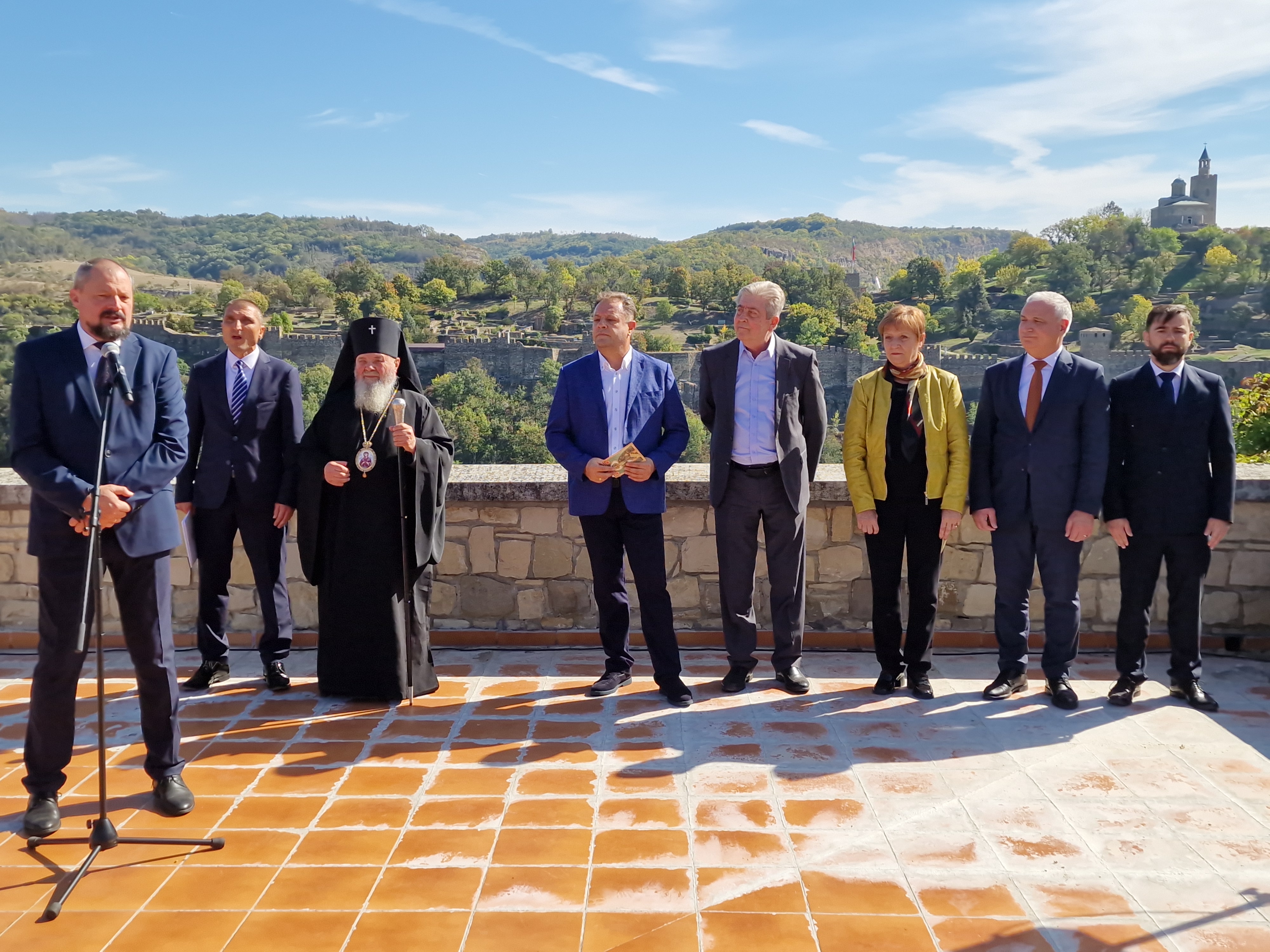

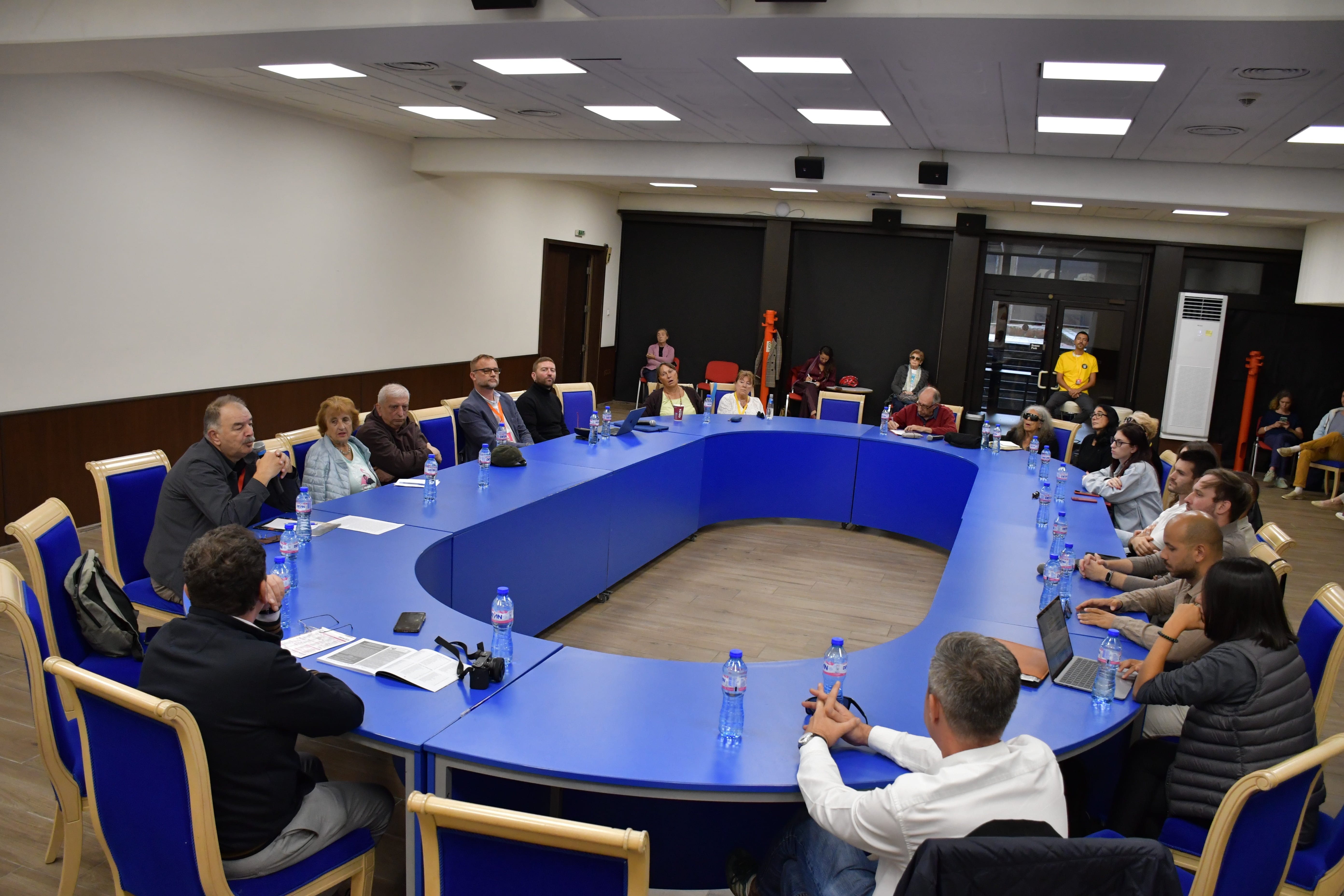
A round-table discussion on the theme “Bulgaria in Europe. The Cycle of Film Ideas: Past and Present” took place as part of the 44th edition of the “Golden Rose” Bulgarian Feature Film Festival, Varna 2026. The event was organised by the Institute of Art Studies at the Bulgarian Academy of Sciences (BAS) as part of a project funded by the Bulgarian National Science Fund.
Participants in the discussion included the director of the festival and of the National Film Centre (NFC), Peter Todorov; Assoc. Prof. Deyan Statulov; Prof. Alexander Donev; Prof. Petya Alexandrova; Prof. Wojciech Južwiak from Adam Mickiewicz University in Poznań; Prof. Bojidar Manov; Dr. Rosen Spasov; Kostadin Bonev, director of the “She Who Remains” film; Stefan Prohorov – the Euroimages Fund’s representative for Bulgaria; Hristo Hristozov, programme director of “Cinemania” and the “Odeon” cinema, and PhD students from the “Screen Arts” sector: Simeon Aleksandar, who is also the Director of the “Culture Office” at the European Commission’s Creative Europe Desk, Stefka Mancheva and Simona Evstatieva, as well as many colleagues from the film industry, and others.
The round table is the first public event of the “Bulgaria in Europe: The Cycle of Film Ideas” research project organised by the Institute of Art Studies at the Bulgarian Academy of Sciences (BAS), announced its coordinator, Assoc. Prof. Dr Deyan Statulov. He noted that it was being organised to mark the 20th anniversary of our country’s accession to the European Union.
The aim is to explore how European cinema features in the Bulgarian landscape, and conversely – how Bulgarian films are received in the West, explained Statulov. He recalled that even during the socialist era, there were Bulgarian filmmakers who were trained abroad in the creation of co-productions, and there were numerous such examples. The results will be published in a monograph following the project’s three-year duration.
The research covers the period from the 1950s to the present day. Co-productions between Bulgaria and other countries will be examined, explained Prof. Alexander Donev, adding that such collaboration had existed since the 1920s in documentary projects. The predominant domestic co-productions during the socialist period were with Czechoslovakia, Poland and the GDR, to a lesser extent with Hungary, and there were also some with Italy. “We will outline the processes of industrialisation in the field of film production and highlight various interesting case studies,” added Prof. Donev.
The topic of how European cinema was covered in the specialist press in Bulgaria was being examined for the project by Prof. Petya Alexandrova. She is responsible for the period up to 1989 and is researching the publications LIK, “Film News” and “Cinema Art”. What she finds interesting is the extent to which our periodicals adequately covered developments in Western cinema. In her words, the articles from those years were not so much ideologically driven as they were tailored to audience interest which is why there were frequent pieces on comedies and actors from that genre. After the 1970s, attention was focused more on American cinema than on European cinema, she noted.
Dr Rosen Spasov, who is also working on the project, emphasised that co-productions were not limited to new film productions but also extended to the restoration of classic films. One of the Bulgarian films to have recently undergone this process is “The Peach Thief” which was screened in its new version at the Lumière Festival in Lyon to great audience interest and an additional screening, explained Spasov.
At the round-table discussion, Peter Todorov, director of the “Golden Rose” Festival and the National Film Centre – who is currently also a PhD student at the Institute of Art Studies – commented that Bulgaria was an increasingly sought-after partner for film co-productions. New agreements are being signed with countries on the Balkan Peninsula but there are also collaborations with Western Europe and Canada. According to him, the results are already visible but will become even more noticeable in the future as it takes several years to produce a film.
You can find more information about the project at https://bgcinema.eu