
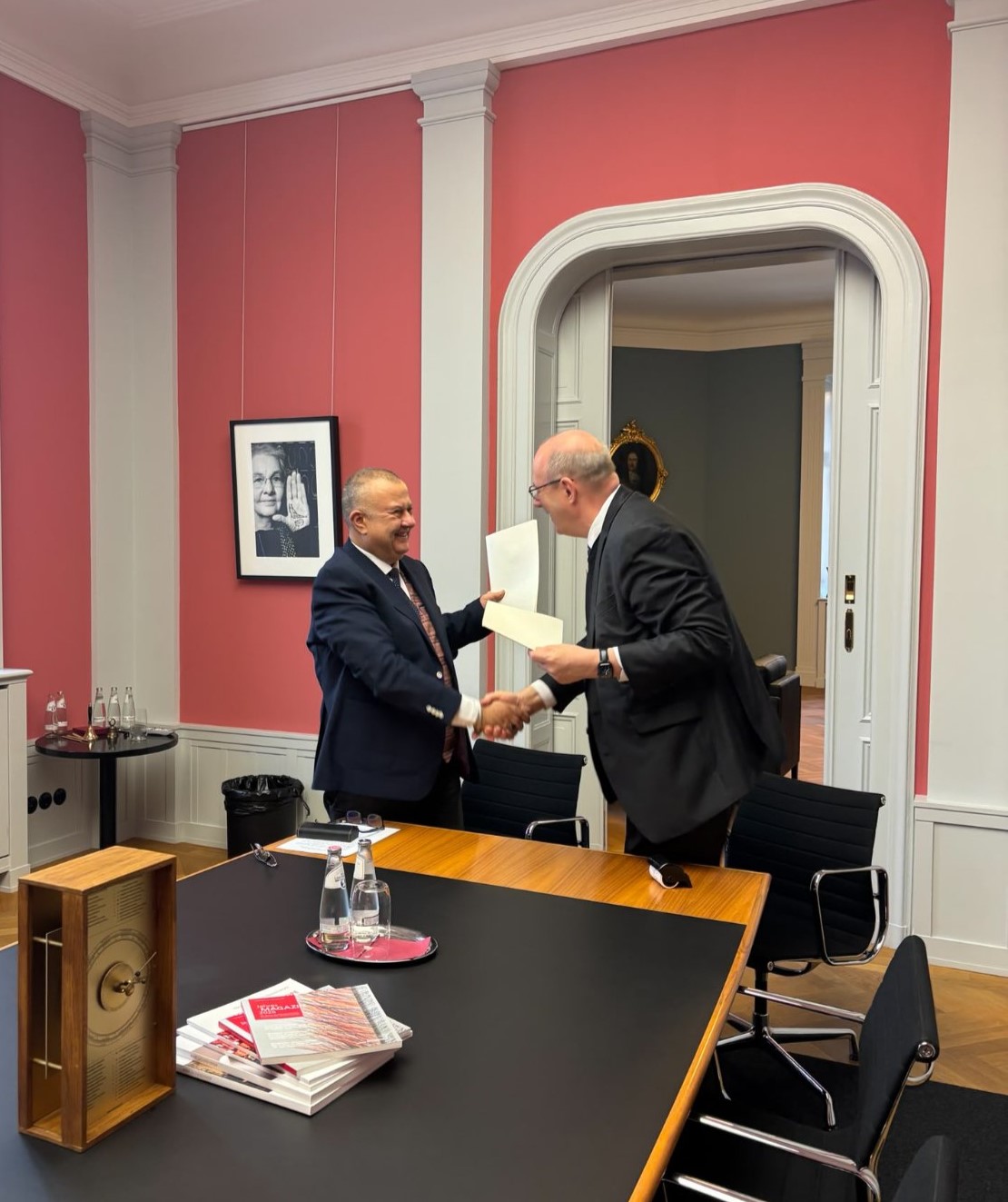
 The Vice-President of BAS, Prof. Emmanuel Moutafov, and the President of the German academy, Prof. Dr Christoph Markschies, signed the new strategic partnership
The Bulgarian Academy of Sciences (BAS) and the Berlin-Brandenburg Academy of Sciences and Humanities (BBAW) officially signed a Memorandum of Understanding on 8 November in Berlin. The document which marks the beginning of a long-term strategic partnership within the European Research Area was signed by the Vice-President of BAS Prof. Emmanuel Moutafov, DSc, and the President of the German academy, Prof. Dr Christoph Markschies.
The official signing ceremony took place in Berlin as part of the prestigious international forum, the Falling Walls Science Summit Berlin. “This forum which celebrates the breaking down of walls in science and society provides the perfect backdrop for our event today. By bringing our two academies closer together, we are also breaking down barriers, pooling our scientific potential and fostering open international dialogue,” emphasised Prof. Moutafov in his speech.
The signing of the memorandum is a natural continuation of the intensive academic dialogue between the two institutions which began during the General Assembly of the Union Académique Internationale in Mainz last year. Prof. Markschies’ subsequent official visit to Sofia and his meeting with the President of BAS, Corresponding Member Prof. Evelina Slavcheva, DSc, outlined the strategic areas of mutual interest. These encompass both fields fundamental to both academies, such as archaeology, linguistics and sociology, as well as contemporary challenges related to artificial intelligence and digitalisation.
The official document provides for a wide range of joint activities:
- Organising joint scientific forums, symposia, workshops and lectures in key agreed areas;
- Intensive academic exchange, with a particular focus on young researchers who represent the future of both academies;
- Direct collaboration between specific projects, institutes and working groups to achieve tangible scientific results;
- Sharing of expert knowledge and joint communication of science for the benefit of society.
The agreement establishes a flexible and shared financial framework under which the host country covers the local organisational costs of joint events, whilst each institution funds the travel expenses of its own delegations. Provision is also made for the joint pursuit of external funding from third countries.
“Our relations are built on the principles of collegiality, reciprocity and deep mutual respect. This is a partnership between equals – between two communities with a rich history and a clear vision for our European future,” said Prof. Moutafov, expressing his confidence that the signed agreement will inspire new inventions and make a significant contribution to the European Research Area.