
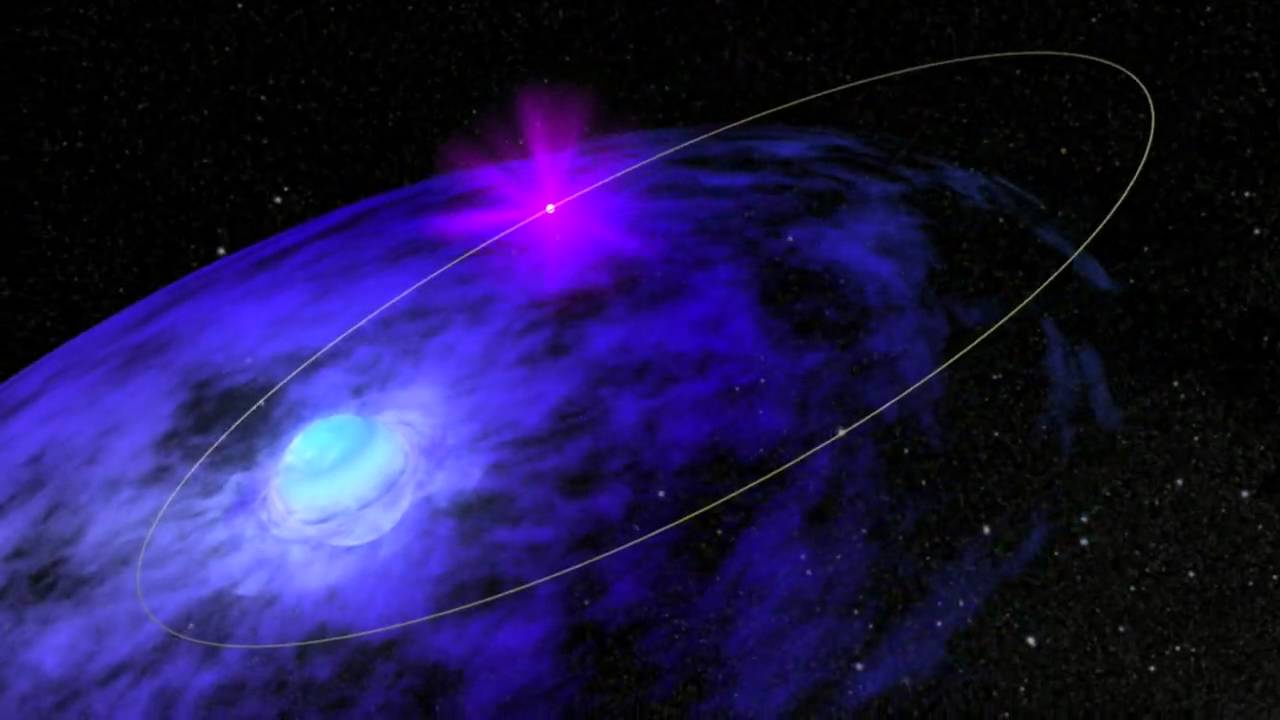
Diagram of a classic Be-type X-ray binary star. Source: Walt Feimer, NASA/Goddard Space Flight Center
The results of the study conducted with the 2m telescope at NAO Rozhen are published in “Astronomy & Astrophysics”.
The study of the 4U 2206+54 star whose magnetic field is trillions of times stronger than that of the Sun was named the most significant scientific achievement of the Institute of Astronomy with NAO – BAS for 2025. The results of the study of key characteristics of this binary system were obtained through observations with a 2-meter telescope at NAO Rozhen and published in the authoritative “Astronomy & Astrophysics” journal. The research was carried out by an international team of astronomers led by Assoc. Prof. Kiril Stoyanov and included PhD student Miroslav Moyseev, Assoc. Prof. Yanko Nikolov, Prof. Radoslav Zamanov, Assoc. Prof. Georgi Latev from the IA with NAO, as well as Dr. Krystian Ilkiewicz from Poland and Dr. Valery Hambaryan from Armenia.
4U 2206+54 is a Be-type X-ray binary star in the Cepheus constellation consisting of a rapidly rotating O-type star with an unusually high helium content and a neutron star with an extremely strong magnetic field. It is one of the few known candidates for a new class of objects — accreting magnetars. Magnetars are objects with magnetic fields many times stronger than those of ordinary neutron stars. They are powerful sources of X-ray and gamma-ray radiation. When they are found in a binary system, where they are fed by the material of donor stars, they are called accreting magnetars. Their exact number is unknown because they are very difficult to detect, but there are fewer than 10 candidates for these exotic objects, including 4U 2206+54.
An interesting feature of this star system is the absence of type I or II X-ray bursts. Classic Be X-ray binaries consist of a hot, rapidly rotating Be star and a compact object, most often a neutron star, which accretes material from the Be star’s circumstellar disk. This material begins to fall toward the neutron star under the influence of its strong gravitational field. As it falls, the material accelerates to very high speeds and heats up to tens of millions of degrees. The kinetic energy is converted into heat and emitted in the form of X-rays.
About 2.8 million years ago, the 4U 2206+54 system was ejected from the Cep OB1 stellar association as a result of a supernova explosion which formed a neutron star – a discovery published in 2022, also with Bulgarian participation. This system is key to a better understanding of the evolution of massive X-ray stars, the mechanism of accretion, and the influence of strong magnetic fields on processes in binary systems.
Using high-resolution spectroscopy and spectropolarimetry, obtained entirely with the 2m telescope at NAO Rozhen, the structure and changes in the circumstellar disk that feeds the neutron star with material were tracked. The measurements show that the radius of this disk is between 8 and 15 times larger than the radius of the Sun. This means that the orbit of the neutron star is too far from the outer edges of the disk for a large amount of material to accrete.
Spectropolarimetric observations show a weak depolarizing effect on the emission lines, which, on the one hand, indicates the presence of a small circumstellar disk and, on the other hand, allows the characteristics of the interstellar medium around this object to be determined.
Link to the publication:
https://www.aanda.org/articles/aa/full_html/2025/05/aa54256-25/aa54256-25.html
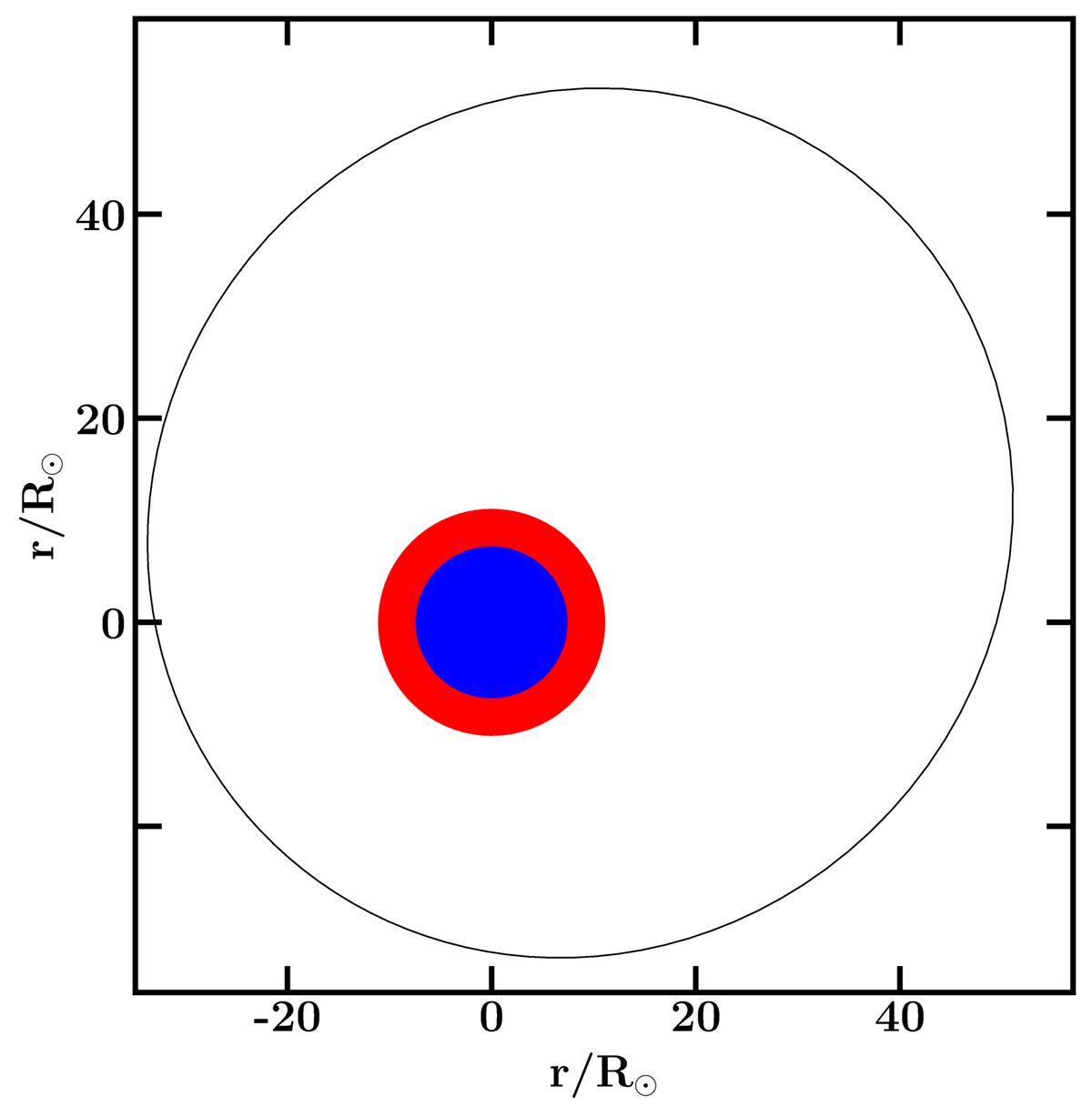
The orbit of the neutron star (in black) compared to the donor star (blue) and the circumstellar disk (red)