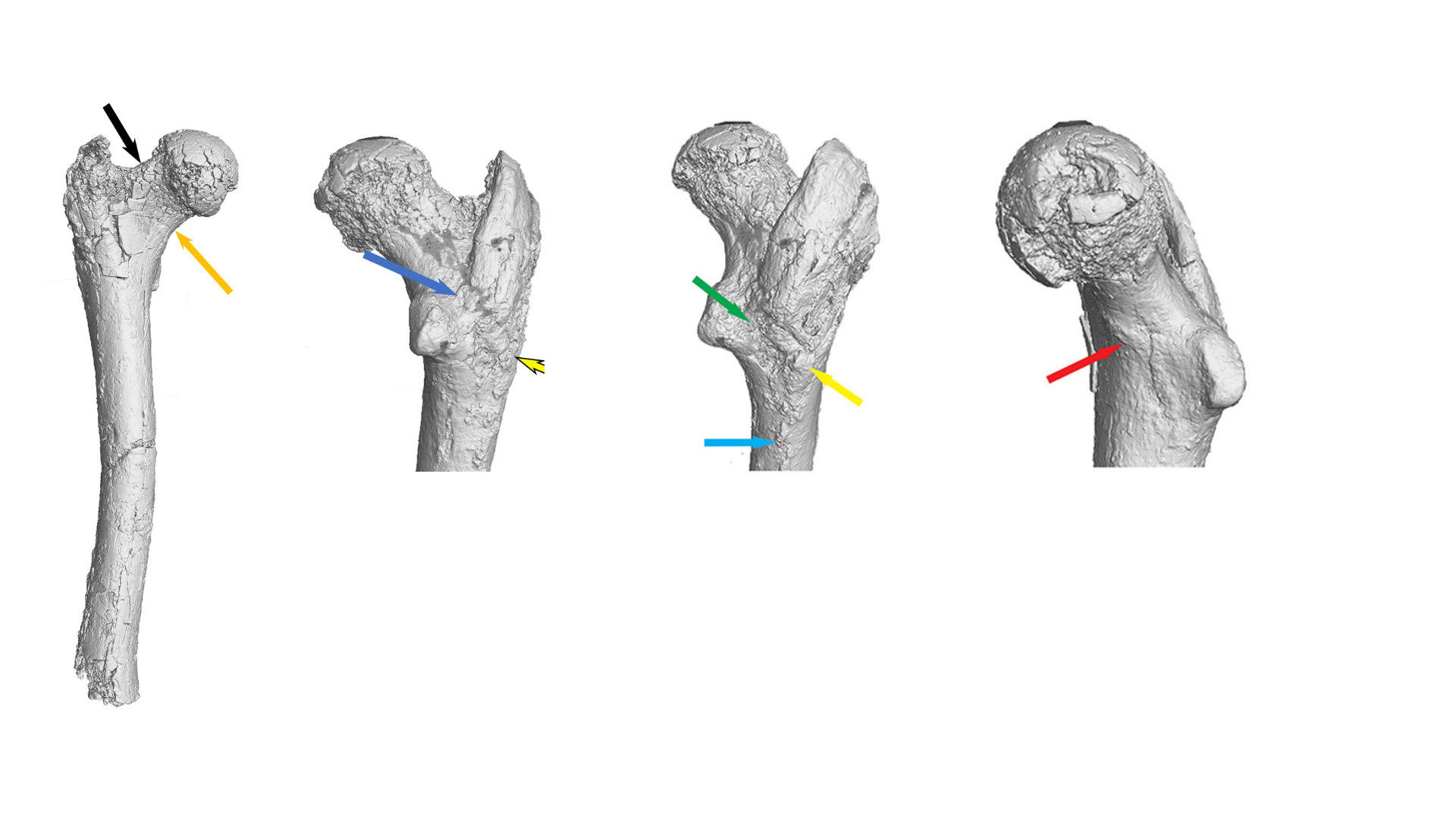


A new fossil femur, or thigh bone from Bulgaria could re-write the story of human origins. This is the conclusion of an international team of researchers from the National Museum of Natural History at the Bulgarian Academy of Sciences (Bulgaria), the Aristotle University of Thessaloniki (Greece), the Eberhard Karls University of Tübingen (Germany), and the University of Toronto (Canada). Bipedalism (walking on two legs) has long been considered a fundamental threshold in human evolution and one of our most formative attributes. Until now, researchers thought that the first humans were from Africa and that bipedalism evolved there between 6 and 7 million years ago. But the new femur, from the site of Azmaka, Chirpan area (Bulgaria), described in an article, published on March 4, 2026 in Palaeobiodiversity and Palaeoenvironments scientific journal, has unmistakable attributes of a biped, a human ancestor that was already walking on its hindlegs.
The authors of the study believe that the femur of this ancestor, dated to 7.2 million years ago, belonged to Graecopithecus whose first discovery (lower jaw) was found near Athens during World War II. They also believe it may be the oldest direct ancestor of humans. Graecopithecus, first discovered at a site near Athens (Greece), lived in a savanna environment, like East Africa today, and probably needed to move bipedally to see across the horizon (scanning for both food and predators) and to carry important items. But this hominid was not yet able to move bipedally in the way that humans walk. The femur from Azmaka near Chirpan combines attributes of terrestrial quadrupeds (knuckle-walkers) – the higher African apes, and bipedal pre-humans and modern humans. It represents a stage in human evolution between our tree-living and ground-living ancestors that can fairly be called a missing link. Graecopithecus most likely descends from the older Balkan-Anatolian apes Ouranopithecus and Anadoluvius, which in turn evolved from ancestors in Western and Central Europe such as the Dryopithecus. With climate change these apes most probably moved by different waves into Africa to become the ancestors of the African apes (chimpanzees and gorillas) and humans. We know that today’s African savanna fauna largely originates from the late Miocene fauna of the Balkans and western Asia (Greece, Bulgaria, North Macedonia to Türkiye and Iran). These large scale movements of mammals to Africa, between 8 and 6 million years ago, were caused by aridification and the development of the Arabian Desert. The authors of the study suggest that Graecopithecus also migrated to Africa from the southern Balkans, which led to the origins of early human ancestors such as Orrorin, Ardipithecus and Lucy (Australopithecus afarensis). Work is continuing at Azmaka and other sites in the Balkans to learn more about the ecology and evolution of this surprising early biped and possible human ancestor.
The article Spassov N., Youlatos D., Böhme M., Bogdanova R., Hristova L., Begun D.: An early form of terrestrial hominine bipedalism in the Late Miocene of Bulgaria is available on the website of Palaeobiodiversity and Palaeoenvironments