
Prof. Kamen Kozarev is the director of the Institute of Astronomy with NAO – BAS

Prof. Kamen Kozarev is the newly elected director of the Institute of Astronomy with the National Astronomical Observatory at the Bulgarian Academy of Sciences. His scientific work focuses on solar and heliospheric physics, and especially on solar flares, coronal shock waves, the acceleration and transport of high-energy particles, and the application of modern data processing methods and artificial intelligence in radio astronomy and space weather. His professional career includes many years of research experience in the United States. He worked as a doctoral student and postdoctoral fellow at Boston University and the Harvard -Smithsonian Center for Astrophysics, where he developed numerical models for the acceleration of charged particles in coronal and interplanetary shock waves and analyzed ultraviolet and radio observations of the Sun from space [...]
The Bulgarian LOFAR radio telescope will become operational in 2026

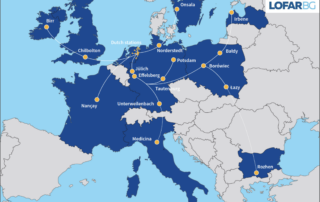
The Institute of Astronomy with NAO offers opportunities to participate in its construction through summer internships for students, doctoral students, and young scientists. By the end of 2026, Bulgaria will complete the construction of the first observatory in Southeast Europe for the world's largest low-frequency radio telescope – LOFAR (Low Frequency Array). This is a pan-European project involving 52 antenna stations in eight countries: the Netherlands, Germany, Poland, France, Ireland, Latvia, Sweden, and the United Kingdom. An expansion with additional stations in Italy and Bulgaria is underway this year. Research into the Universe using the LOFAR radio telescope, headquartered in the Netherlands, covers scientific fields such as solar and space weather, the study of the early Universe, galaxy formation, pulsar physics, transient radio phenomena, ultra-high-energy [...]

Research on a star with a magnetic field trillions of times stronger than that of the Sun is the most significant scientific achievement of the Institute of Astronomy with NAO for 2025.

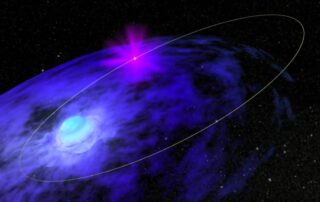
Diagram of a classic Be-type X-ray binary star. Source: Walt Feimer, NASA/Goddard Space Flight Center The results of the study conducted with the 2m telescope at NAO Rozhen are published in “Astronomy & Astrophysics”. The study of the 4U 2206+54 star whose magnetic field is trillions of times stronger than that of the Sun was named the most significant scientific achievement of the Institute of Astronomy with NAO - BAS for 2025. The results of the study of key characteristics of this binary system were obtained through observations with a 2-meter telescope at NAO Rozhen and published in the authoritative “Astronomy & Astrophysics” journal. The research was carried out by an international team of astronomers led by Assoc. Prof. Kiril Stoyanov and included [...]

“Blue Planet Outside the Window” presented at BAS

The “Blue Planet Outside the Window” Chinese documentary film, shot entirely in space and produced by the China Media Group, was presented in the “Prof. Marin Drinov” Hall on November 30. “Blue Planet Outside the Window” was filmed by the crew of the Shenzhou-13 mission. The film follows the daily life and work of the Shenzhou-13 mission crew - taikonauts Zhai Zhigang, Wang Yaping, and Ye Guangfu. Viewers witnessed their six-month stay at the Tiangong orbital station documented in exceptional detail. The production shows not only the scientific experiments and spacewalks, but also the human side of life in orbit – from eating in zero gravity to moments of awe at the view of Earth. One of the key factors in the film's success is [...]

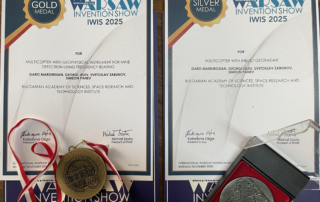
Gold and silver medals for inventions by SRTI-BAS

In November 2025, the Polish capital hosted the latest International Warsaw Invention Show (IWIS). Around 250 inventions from over 20 countries in 12 categories participated in person and remotely. At a formal ceremony, a team from the Space Research and Technology Institute at the Bulgarian Academy of Sciences (Prof. Garo Mardirossian, Prof. Georgi Zhelev, and Assoc. Prof. Svetoslav Zabunov) and Prof. Simeon Panev from the Technical University of Sofia were awarded one gold and one silver medal for three inventions in the "Mechanics and Engineering" category.

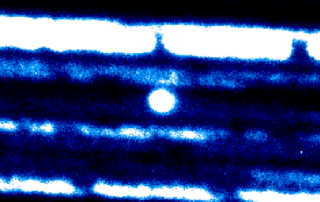
The newly discovered comet 3I/ATLAS is observed by telescopes at NAO Rozhen

  Text Figure 1:Composite image of 275 shots in filter R, each 22 s. The white stripes represent background stars, which merge into so-called star treks when the images are combined, and the comet is the white "blob" in the center of the image. The mysterious interstellar visitor is the third to carry unique information about the composition of matter outside the solar system On 1 July 2025, the ATLAS survey detected comet C/2025 N1 (ATLAS). The very first measurements of its orbit showed that it was the third interstellar object discovered since 2017 (after C/2017 U1 (PANSTARRS) and C/2019 Q4 (Borisov)). Very soon, astronomers around the world started observing the newly discovered object 3I/ATLAS, which, like the first two, carried unique information [...]

Go to Top