An interstellar comet is probably the most pristine object ever discovered

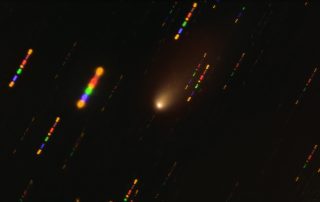
Image of comet 2I / Borisov obtained with the VLT telescope. Image credit: ESO New observations made with the participation of a scientist from BAS using the Very Large Telescope (VLT) of the European Southern Observatory (ESO) show that the unique comet 2I / Borisov, which is only the second newly discovered interstellar visitor to our solar system, is one of the most pristine objects that have ever been observed. Astronomers speculate that this comet never passed a star nearby, making it an intact remnant of the cloud of gas and dust from which it formed. Stefano Bagnulo and his colleagues, including Assoc. Prof. Dr. Galin Borisov from the Institute of Astronomy with NAO - BAS, used the FORS2 instrument of the VLT [...]

National Astronomical Observatory – Rozhen turns 40 years old

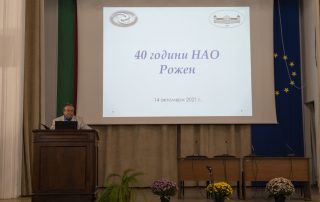
Forty years since the official opening of the National Astronomical Observatory – Rozhen (NAO Rozhen) will be celebrated on 13 March 2021. In its first years, NAO Rozhen is a scientific astronomical complex of three telescopes: a universal 2-meter telescope for photometric and spectral observations and two smaller telescopes: 50/70-cm Schmidt and 60-cm Cassegrain. The first observations were made on photographic plates, and a high-speed electrophotometer was mounted on the Cassegrain telescope. In the first twenty years of the observatory’s work, more than 10 000 photographs of objects from the solar system, stars and star clusters, distant galaxies and quasars, and thousands spectra of interesting stellar objects were obtained. […]

The Rozhen National Astronomical Observatory will have a new robotic telescope

The Institute of Astronomy with National Astronomical Observatory (IA with NAO) has signed a contract for the production, supply and installation of a new telescope at Rozhen NAO. The new telescope will have a main mirror with a diameter of 1.5 meters, Richie-Chrétien optical system and will be manufactured by the Austrian company ASA Astrosysteme Ltd, which won the announced public tender for it. The contract also envisages the construction of an observation tower with a dome, in which the telescope will be installed. The telescope will be fully robotic and remotely controlled and will perform the set program for astronomical observations without human intervention while observing the weather conditions. An automated meteorological station is provided for it, which will monitor the strength and direction [...]

New scientific infrastructure is helping Bulgarian astronomers explore space objects with unique radio observations

LOFAR station in Onsala, Sweden. The low-band antennas (10-90 MHz) are visible on the left, and the high-band antennas (110-240 MHz) - on the right. Source: ASTRON A new scientific infrastructure complex, coordinated by the Institute of Astronomy with National Astronomical Observatory (IA with NAO), will be included in the updated National Roadmap for Scientific Infrastructure 2021-2027 (NRSI). Over the last half century, our knowledge of the universe has been enriched by astronomical observations in the optical, infrared, and ultraviolet regions. But one region of the electromagnetic spectrum remains poorly studied - the low-frequency radio range, indicated the Institute of Astronomy. The LOFAR project for the first Bulgarian radio astronomy observatory, proposed by a team from the Institute of Astronomy with National Astronomical [...]

2020-05-22T19:56:02+03:0021 May 2020|Categories: Astronomy, Space Research and Technologies|

Copernicus Hackathon – Sofia 2020

Copernicus Hackathon - Sofia 2020, which is part of the European Copernicus program, as been running since 24 April. The event is being held for the second time since the successful 2019 edition, and this year, due to COVID-19, it is being held online. Bulgaria is the first EU country to succeed in reorganizing the planned live competition - in an online format, allowing participants from 10 EC countries to be involved. The main topics of the event are: "Smart Cities", " Monitoring of the Danube and the Black Sea", "Earth Observation & Artificial Intelligence for E-Government" as well as specific challenges related to the COVID-19 pandemic: "Monitoring of the changes in air pollution," "Water Quality Assessment" as well as "Assessment of the geographical distribution [...]

2020-04-29T17:53:50+03:0029 April 2020|Categories: Astronomy, Space Research and Technologies|

The Space Research and Technology Institute presented new projects

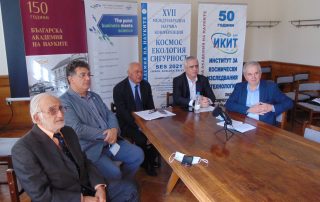
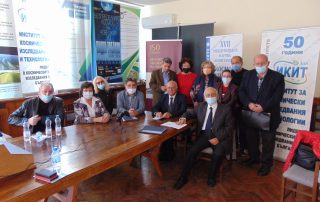
Bulgarian space foods, drones’ capabilities demonstrations and the newest ideas for remote earth sensing from space are just some of the topics that the Space Research and Technology Institute at BAS (SRTI-BAS) spoke about on its Open Door Day on the occasion of the 50th anniversary from its establishment. For the first time, the institute also showed a pilot training simulator. There is also a Technology Transfer Center in SRTI-BAS. A three-dimensional model of Sofia created on the basis of satellite images for analysis and evaluation of air pollution showed the scientists. Another current project is related to the determination of water quality owing to satellite images from space – it has been applied to Varna Lake and Iskar Dam on a test basis. The [...]

2019-11-19T18:05:02+02:0015 November 2019|Categories: Astronomy, Space Research and Technologies|
Go to Top